[New post] Onshore wind rebellion reveals fractious climate politics within the Conservative party
cloudtales posted: "Onshore wind rebellion reveals fractious climate politics within the Conservative party Dave Head / shutterstockCampaigners have sought to overturn planning restrictions banning onshore windfarms ever since then UK prim" Straight To The News That Matters
Onshore wind rebellion reveals fractious climate politics within the Conservative party
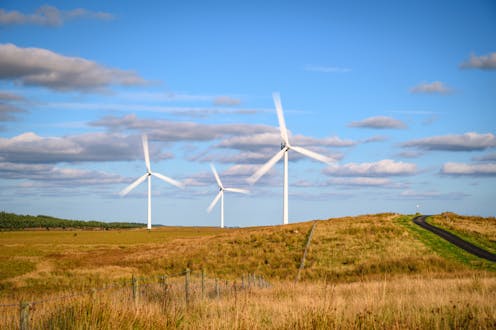
Dave Head / shutterstock
Campaigners have sought to overturn planning restrictions banning onshore windfarms ever since then UK prime minister David Cameron introduced them in 2015. This year, however, there have been signs of movement.
Former UK prime minister Boris Johnson reportedly wanted to allow more onshore wind farms via the April 2022 energy security strategy, but was forced to water down his plans in the face of last-minute backbench and cabinet opposition. Under another former prime minister, Liz Truss, the short-lived growth plan included a relaxation of onshore wind planning restrictions.
Current UK prime minister Rishi Sunak was asked about onshore wind in his first prime minister's questions and implied he would not be going ahead with any loosening of restrictions. However, a group of Conservative backbenchers are now pushing an amendment to the Levelling-up and Regeneration Bill to force the government to do so. With Labour's support they appear to have the numbers to pass it and the government has suggested it is willing to compromise, though the nature and extent of this is yet to be seen. So, why is this issue back on the agenda?
Friends and foes of onshore wind
This recent row follows an eventful few years in the Conservative party's approach to the net-zero challenge, something the environmental politics professor Neil Carter and I recently published a study on.
In imposing the original block on onshore wind projects, Cameron was responding to significant hostility from a group of Conservative backbenchers who had mobilised during the course of the 2010-2015 coalition government. It appears that they had a variety of motivations including personal objections to their visual impact, ideological antipathy to climate policies, and a belief that they were representing the concerns of their constituents or local Conservative activists. Many of those MPs are still in Parliament and have not changed their views.
Nonetheless, those wishing to remove the onshore wind planning restrictions have always had a fairly powerful case. After all, they have been advocating for a technology which can not only cut emissions but, as the cheapest form of new power generation, can also reduce energy bills. Polling has also shown consistent support, in principle at least, for onshore wind deployment even among Conservative voters. (As an aside, polling of Conservative MPs suggests they tend to underestimate public support for onshore wind).
Ideologically, many in the parliamentary Conservative party should be amenable to supporting onshore wind, since the campaigners' main request is just for government to get out of the way by relaxing planning constraints. This is in contrast to many other policies to tackle climate change which can be difficult for some Conservatives to support because they involve government intervention through subsidies, taxes or regulations.
Exploiting the opportunity
The energy crisis brought on by COVID-19 and the war in Ukraine appears to have acted as a focusing event, with the UK government suddenly particularly keen to cut energy bills and bolster energy security. An added advantage of onshore wind farms in this context is that they can be constructed relatively quickly. That said, it is notable that even in an emergency situation, the government response on this so far has been more of a tortured back-and-forth than a straightforward policy change.
Faster than building new nuclear, gas or offshore wind. Jacques Tarnero / shutterstock
Some of the divisions between Conservative MPs help explain the contentious politics of onshore wind in recent months. The divide between passionate advocates of net zero and those who are more sceptical is well known. But there is also a divide between those who say "yes in my backyard" (yimbys) and nimbys or mercantilists and romanticists: Conservatives who are focused on kickstarting economic growth and Conservatives who are highly resistant to building or development projects (often due to fear of opposition in their constituencies).
Fracking nimbys are aligned with environmentalists. seeshooteatrepeat / shutterstock
In this sense, the onshore wind debate is distinct from the fracking debates within the Conservative party where the interests of nimbys and advocates of climate policies are more aligned.
This episode also reflects a classic understanding of governing in Britain: that the executive can generally ignore the opposition but not their own backbench MPs, who are able to drive major policy changes. Labour has consistently supported onshore wind in recent years, but it is only internal dissent which has forced the Sunak administration into listening mode. The ongoing quest to respond to the rebels' aims is a textbook example of the pre-emptive party management British governments usually engage in to avoid the embarrassment of a parliamentary defeat.
However Sunak decides to adjudicate between the differing views of onshore wind among his MPs, it is unlikely to be the last time a Conservative leader finds themselves pulled in different directions on climate and energy policy.
Mitya Pearson receives funding from the Leverhulme Trust.




No comments:
Post a Comment