Three teenage girls, all teased hair and lip gloss, glide up the escalator in their denim miniskirts. A trio of pop-collared boys are going down. In unison, the boys' heads follow the girls. Cuts between shots are fast. Every frame is filled with bright colors and upbeat music. Obviously, I'm watching a 1980s mall movie. It doesn't matter if I'm referring to one in particular—the mall montage has become such a pop culture cliché that parodies are as likely to reference other parodies as they are a scene from an actual movie.
As a Gen Xer, I have a special place in my heart for malls. The Oregon town I grew up in was too small to support one, which meant every excursion was special, a pilgrimage to a temple of consumption. It also meant that, until I moved to Portland for college in the 90s, my knowledge of this essential piece of American culture came mostly from movies, so these scenes are seared into my memory.
The myth of the American mall still looms large in our collective imagination. Recent books like Alexandra Lange's Meet Me by the Fountain and essays like Lili Loofbourow's "Everything Must Go" at Slate have examined the mall's architectural, political, and social significance. But I keep thinking about its mythology. Today, malls have become both shorthand for everything wrong with 21st-century capitalism and a bottomless source of nostalgia, especially as the story around malls becomes one of death and decay. As Lange suggests, there are actually reasons to be optimistic about the future of shopping centers. Many malls (including Portland's beloved Lloyd Center) are reinventing themselves with local retailers and mixed-use spaces. And according to the New York Times, Americans shopped in person more than online in 2021. Yet the dead mall story persists, maybe because it fits better with sentimentality for the pre-digital age.
I'm always suspicious of unchecked nostalgia—so, while I enjoy watching Jeff Spicoli hang out in cutoffs at the arcade, I also think there's value in removing our rose-colored Ray-Bans and considering what we really miss when we say we miss malls. And so, I embarked on a mission to rewatch iconic mall scenes from my tween and teen years. I told myself it was research—therefore, it was my duty to be thorough.
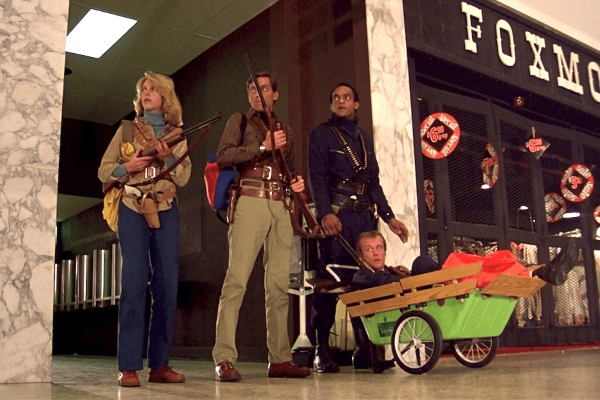
Dawn of the Dead (1978)
The obvious kick-off for my movie marathon was George Romero's Dawn of the Dead. Premiering just before the new decade, it was possibly the first popular film to use the mall as both a central set piece and a metaphor for consumer culture. The film, in which zombie hordes flock to the mall because the drive to consume is all that's left of their former selves, isn't subtle. It is, however, a very good time. One famous scene depicts every 20th-century shopper's fantasy: Having cleared the space of zombies, the band of survivors go on an unchecked spree. They try on clothes, eat fancy olives from the jar, ice skate, and play video games. It's silly and fun and we know it can't last. Eventually a biker gang intrudes on their paradise, letting the undead back inside. This tension between the pleasure and the violence of shopping set the tone for a lot of later films that framed the mall as a place of gleeful excess as well as danger.
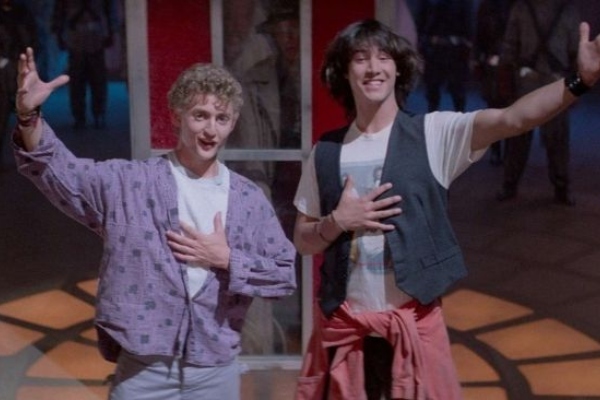
Bill and Ted's Excellent Adventure (1989)
At the other end of the decade, a similarly destructive mall chase pitted Western civilization's greatest minds (according to San Dimas High School's baffling history curriculum) against a Keystone Cop–like pile-on of security guards. In Bill and Ted's Excellent Adventure, even the most famously strong-willed figures in history, including Socrates and Joan of Arc, can't withstand the mundane pleasures of sporting goods stores and ice cream parlors.
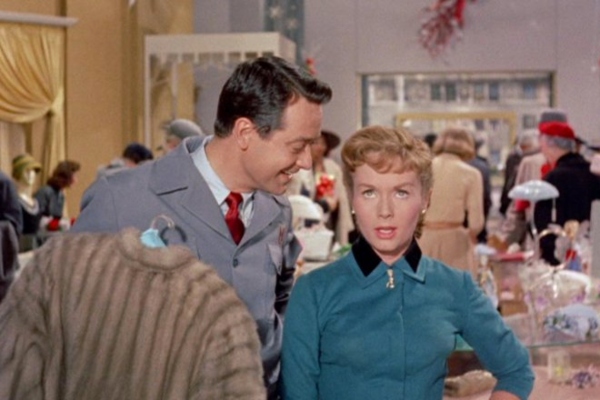
It (1927), Our Blushing Brides (1930), Bundle of Joy (1956), and Along Came Love (1936)
There's something captivating about the push-pull of exuberance and anxiety that shopping centers inspired in the 80s. I experienced this tension as well: In seventh grade, my best friend and I could split a pretzel, flirt with boys, and try on all the Guess miniskirts in the world—we just couldn't take anything home. Had we grown up in the earlier era of department store movies, we might have imagined our lack as aspirational.
An industry staple from the 1910s through the 1950s, department store films were often told as Cinderella stories in which a poor shopgirl married her boss. There are countless examples, but a starter kit includes the Clara Bow vehicle 'It', Our Blushing Brides with Joan Crawford, and Debbie Reynolds in Bundle of Joy. Even when the plot didn't hinge on marrying the boss, the department store was usually the movie's hero. In Along Came Love, the wedding finale even took place on an escalator: a spunky shopgirl and aspiring pediatrician rose from the bargain basement to the main floors in a tableau of upward mobility.
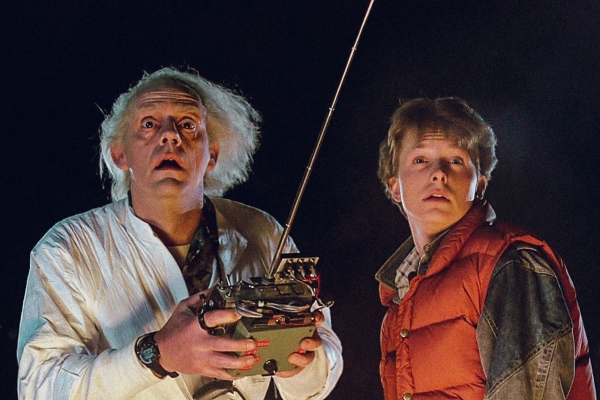
Back to the Future (1985)
Between the 50s and the 80s, department stores gave way to malls, which were imagined as modern, idealized town centers for segregated suburbanites. At the same time, civil rights movements, war, and recession all challenged the middle-class white fantasy that malls were invented to represent. By the 80s, as suburban shopping centers proliferated, their patrons also became more economically and racially diverse. Movie malls, meanwhile, stayed focused on white, mostly middle-class concerns. It makes sense: Hollywood tends to reflect dominant US culture, and that culture was holding onto 50s nostalgia with a white-knuckled grip. When Reagan was elected in a landslide victory, he promised to undo the gains that women, minorities, and labor activists made in the previous decades and, um, make America great again.
Unsurprisingly, malls played a role in this story, too. Remember how Michael J. Fox and Christopher Lloyd tested their time machine in a mall parking lot in 1985? And then Fox traveled back to 1955, when the space was all bucolic farmland and teens gathered at the malt shop in the town center? The point of Back to the Future—aside from rewriting rock and roll history to put a suburban white boy at its center—was that the family's financial struggles were all due not to dissolving labor rights or the actual decline in livable working-class jobs, but to the father's lack of confidence as a youth. Fix that, and the reward is generational wealth.
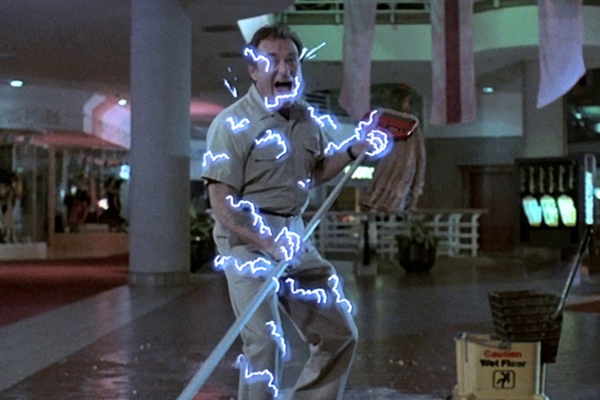
Night of the Comet (1984) and Chopping Mall (1986)
Unlike department store movies, malls usually extracted a price for pleasure—even when the world was ending. Two B-horror sci-fi comedies starring Kelli Maroney provide great examples. In Night of the Comet, two valley girls are among the only survivors of a comet that mostly killed people but sometimes turned them into zombies. When Maroney gets bummed that, like, everyone she knows is dead, her sister takes her shopping. For a few glorious minutes they're in full montage mode—trying on floppy hats, dancing on stairs, sampling lipsticks—but the party ends when they're attacked by partially zombified stock boys. Their leader's monologue directly mocks the department store narrative. Revealing his half-melted face, he declares, "The system works! Why, just a few days ago we were only stock boys. Now we own the store. The American way!"
In Chopping Mall, technology designed to protect commodities turns deadly for humans. Both films revel in unfettered access to all the goods global capitalism made available to Americans. And both reveal the mall to be a space where humanity comes in second to capital.
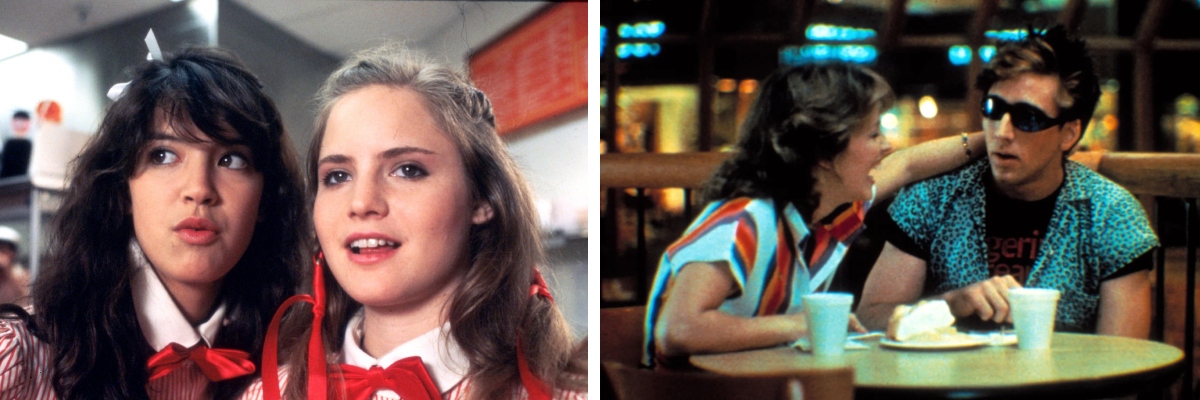
Fast Times at Ridgemont High (1982) and Valley Girl (1983)
Did any of the classics depict malls as uncomplicated fun? I could only think of two, but they're just as foundational as Dawn of the Dead. Where Romero's film established malls as spaces of hedonistic pleasure and violence, Fast Times at Ridgemont High and Valley Girl cemented their importance as teen kingdoms. Yet in Valley Girl, the mall isn't a site of punishment, humiliation, or danger. In fact, the titular valley girl (Deborah Foreman) and her wrong-side-of-the-tracks guy (Nicolas Cage) have some nice times in the food court.
Similarly, in Fast Times, most of the tension happens at home and school. That film is also unique in that its mall is primarily a workplace, which offers a clue as to why it's less disturbed by a shopping-based world than other entries in the genre. Mall jobs in Fast Times have a clear hierarchy: the pizza parlor where the girls work is at the top, while the movie theater where the boys work and hang out barely registers. In other words, the kingdom is more of a queendom.
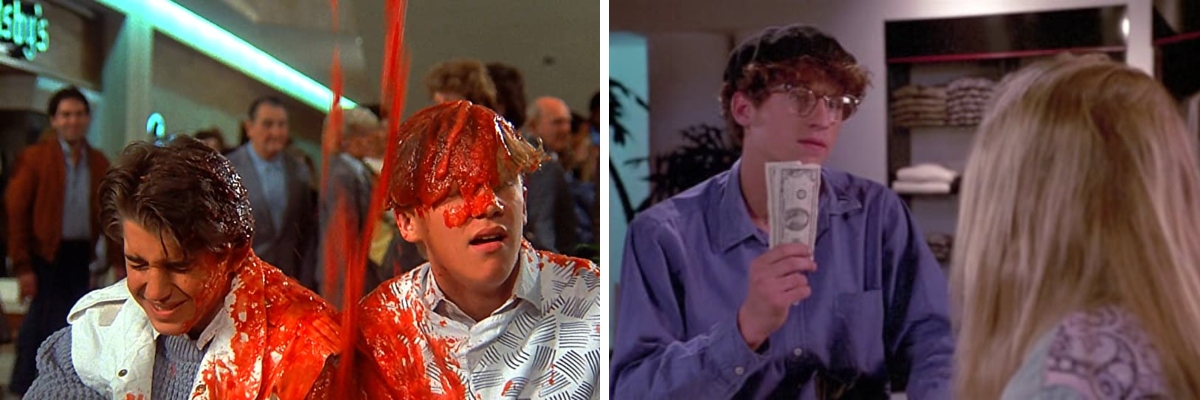
Weird Science (1985) and Can't Buy Me Love (1987)
And queendoms they were: early shopping centers were specifically designed to meet the needs of women (or what developers thought those needs were). Department stores had already converted shopping into a feminine leisure activity. Early malls, as scholar Lizabeth Cohen explains, went even further: "From color schemes, stroller ramps…to reassuring security guards and…fashion shows, shopping centers were created as female worlds."
So, malls were meant to be women's spaces before teens took them over. Hollywood was happy to exploit this new connection, but it created a narrative problem that reflected a larger cultural shift: how could boys be properly masculine in a space designed for girls? What I saw in films like Weird Science and Can't Buy Me Love—as well as Back to the Future and Chopping Mall—was white, straight, middle-class masculinity finding a way to maintain supremacy in an increasingly consumer and service-based (i.e. feminine) economy. According to these examples, the solution is:
1. Inventing a hot computer lady and using her for mall-based revenge
2. Buying a hot girlfriend
3. IDK, maybe resisting the urge to date your hot mom?
4. Blowing stuff up.
Fast Times and Valley Girl, both directed by women (Amy Heckerling and Martha Coolidge, respectively), might not be feminist masterpieces, but they are, in my opinion, the best of the genre. Neither portrays shopping or working in a mall as a threat to personhood. It just is.
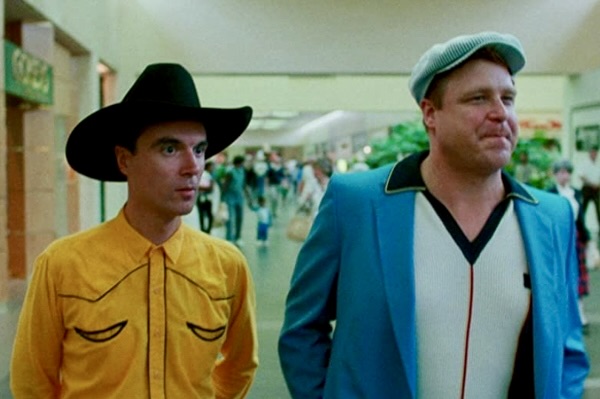
True Stories (1986)
What to make, then, of mall mythology then and now? In True Stories, David Byrne's homage to the weirdness of "normal" American life, he dedicates an extended monologue to shopping malls, noting that in the fictional town of Virgil, Texas, people don't care if they shop "in a funky old building downtown or in a clean modern place like this." He presents shoppers seeking convenience and community in a space that "replaced the town square as the center of many American cities. Shopping itself has become the activity that brings people together." His observations are earnest and upbeat.
But in a tracking shot past a familiar row of stores, the speech spirals into nonsense. His awkward pauses combined with jerky edits transform an average mall into an alien space. The scene felt viscerally truer to my real 80s mall experiences than anything else I'd watched. Turns out a surreal indie film provides the most accurate encapsulation of late 20th-century attitudes toward malls: enthusiastic, nervous, a little nostalgic for the lost downtown, and, as Byrne says, "making it up as they go along."
I don't know if malls are dying or transforming, and whether that's good or bad. With no Delorian to take us back there, it's easy to imagine the past as cleaner and more cohesive than it was. But forgetting and returning helped me look past nostalgia and see something so familiar I'd lost touch with it: In the 80s, malls were exciting spaces of possibility. They were also exclusionary and stifling. They were reassuringly predictable in an unpredictable world. They also enriched corporations at the expense of local communities. More comforting than escaping to the past is realizing that my own anxiety-tinged nostalgia isn't new. Malls have always been a source of tension in American culture.


No comments:
Post a Comment