Ramona Ausubel is a master at creating distinctive young female characters. Lena, the eleven-year-old narrator of Ramona Ausubel's first novel, No One Is Here Except All of Us, inspired by her Romanian-born grandmother's stories, has an uncanny aura of innocence and hope as she describes how the people of her village reinvent the world during the Holocaust.
The Last Animal, her new novel, evolves through the perceptions of Eve and Vera, two prescient and witty teenage sisters who discover the remains of a baby woolly mammoth while on a research trip to Siberia with their recently widowed mother. Jane, a scientist, fell in love with ancient humanoids, evolutionary ancestors, after taking a class from their anthropologist father Sal, and joining him on a research trip to Kenya. Ausubel, who dedicates the book to "my mom and my sister," is familiar with the mother-daughters dynamic.
"My mom raised my sister and I mostly on her own (though my sister and I are further apart in age than the sisters in the novel)," she explains, "and that triangle dynamic is something that I felt drawn to. In the book the husband and father has recently died, leaving the three women to orbit his absence. He's almost like the empty space in the triangle they form and so much of the novel is about the three women trying to figure out how to be each other's people in this new formation. I wanted to write toward a set of relationships between characters who depend on one another for everything in a situation well beyond any of their comfort or understanding." The result is an intense portrait of family dynamics that undergirds a speculative narrative that is just on the verge of real, and also filled with hope. Our exchange took place in the early Spring.
*
Jane Ciabattari: How has your life been going during these times of pandemic, tumult and uncertainty? How has this time affected the completion and launch of your new book, The Last Animal?
Ramona Ausubel: Now that we are all (mostly) back in the swing of living life together I am even more aware how intense the last years were. We will all be unpacking the experiences and feelings for a long time, I think! My jackpot good luck is that I live with two fantastic children and my husband is my best friend and we got a puppy and a cute little vintage travel trailer and spent a lot of time together trucking around. There was so much struggle and fear and homeschool and at the same time we had each other.
There's a sharp edge of sarcasm and necessary dark humor along with a very sincere investment in doing what they can.
I was also lucky to have lovely students on the other end of my Zoom screen who workshopped their stories and stayed invested in each other as writers and that made it possible for me to keep writing, too. I started a new job at Colorado State University in the fall of 2019 with the promise to myself that I would finish a draft of The Last Animal by the end of the year and somehow—this seems even more unlikely to me now in retrospect!—I still managed to do that despite the lockdown and switch to online classes.
JC: What inspired The Last Animal?
RA: I saw a news story about teams working to gene-edit elephant DNA to look like mammoth DNA with the eventual plan to reintroduce the woolly mammoth. It just seemed like the most fertile territory for a novel between the hope behind replacing rather than diminishing diversity on the planet, alongside hubris, possible unintended consequences and the fuzzy creatures themselves.
JC: Your opening line is a superb summary image of your story: "In the Age of Extinction, two tagalong daughters traveled to the edge of the world with their mother to search the frozen earth for the bones of woolly mammoths." At what point in your process did you write it?
RA: Thank you so much, Jane! I'm constantly telling my students that the first chapter is likely to be the last thing they get right, which it certainly is for me. If I remember correctly that first line came in a late draft—maybe the fourth?—once I understood all the scenes that needed to be sown in the beginning. We might think books are written in the order that they're read but I've definitely never had that experience!
JC: Sisters Eve and Vera tag along on Jane's expedition to Siberia with her male colleagues, most of whom treat her as an assistant rather than a colleague. Their observations of their mother's situation are spot-on, as are their playful games and explorations. They are a new generation of women concerned about climate change and extinction, being shaped by their mother's experience. How did you figure out how to show that so carefully?
Our species is responsible for much loss and this could be a way for us to replace some of what we've broken.
RA: I see this in my self, having grown up with parents who were very concerned with climate early on and yet our relationships with the problem (and sources of hope) are subtle different. I also see it in my students who, in their twenties, are preparing to engage and survive and care for themselves and others through a lot of very unknown phases to come. There's a sharp edge of sarcasm and necessary dark humor along with a very sincere investment in doing what they can.
JC: What sort of research was involved in writing a book that includes time spent in the Siberia, Berkeley, Iceland, and a castle and preserve for exotic animals in Italy?
RA: Ha, what a list, right? I did research on CRISPR and gene editing first, then dove back in to the books and internet when I needed to. I have not been to Siberia but I have been to the other places (and lived in Berkeley a few times) but during the pandemic it was a nice respite to spend an hour moving around Lake Como or Siberia or Iceland on Google maps and imagining those distant places. My approach to research is medicinal, meaning I want just enough information to get me writing again and not so much that the facts overwhelm my creative process.
JC: How has your uncle, Jesse Ausubel, noted in your acknowledgements for scientific projects from China to Panama to Russia and for "keeping me up-to-date on all things mammal," influenced this book? What other research was involved?
RA: My uncle is the coolest and most fascinating person. He has done all sorts of wildly varied projects from starting and heading The Census of Marine Life, which aimed to set a baseline for all marine life (i.e., count all the fish in the sea!), to looking at sound pollution in the ocean to studying Leonardo Davinci's DNA. He's also friendly with some the folks working on de-extinction projects so he had the inside scoop and kept me abreast of articles and developments. In many ways our fields are utterly different (I make things up for a living and he studies facts) but both involve a lot of What Ifs and imagining what could be possible and asking of big questions.
JC: How far advanced is the gene editing the NPR announcer in your novel refers to as a "Pandora's box" and how might we see if in daily life today?
RA: Not far at all. Colossal, a private synthetic biology company founded by scientist George Church and entrepreneur Ben Lamm, claims they could have "cold adapted elephant" (which they'll get by swapping out traits in the DNA of an Asian elephant for traits that match the woolly mammoth) by later this decade. There are also projects to bring back the dodo and the passenger pigeon and other projects that aim to use DNA from extinct or distant relatives to increase the gene pool for endangered animals.
JC: The idea of embedding woolly mammal embryos in an elephant and bringing an extinct creature back to life seems both fantastical and realistic. Which is it?
RA: It's both! We will definitely see this in the near future. Isn't that wild? What will happen??
JC: The couple in Italy who take in the pregnant elephant who gives birth to the baby Jane calls Pearl are outside the scientific community. Are there indeed people who are fostering experimentation of this sort? And selling the offspring?
RA: This part came completely out of my imagination, although as the gene-edited animals are born in the real world, which will most likely happen in a lab rather than a private zoo, they will enter real ecosystems with other real creatures. And humans are humans, right? So surely there are profiteers waiting in the wings. Some of the projects seem to have the best possible intentions—our species is responsible for much loss and this could be a way for us to replace some of what we've broken—while others seem driven by less altruistic motives.
JC: What are you working on now?
RA: I have a mix of teeny seedling projects. I've got a handful of short stories going and I'm teaching a novel writing class in which we are (myself included) aiming to get a good chunk of the way through a draft of a longer work. I've also been working on an idea for a craft-of-writing book on getting unstuck.
__________________________________
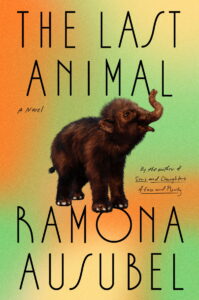
The Last Animal by Ramona Ausubel is available from Riverhead Books, a division of Penguin Random House, LLC.


No comments:
Post a Comment